2024-09-21 · 12 min
Large Language Models: The Wizards Behind Your Text Generation Magic
Once upon a time, in the mysterious realm of machine learning, Large Language Models (LLMs) were the secret sauce of AI wizards working away in secret labs. Fast forward a few years, and now? These digital sorcerers are everywhere coding for software engineers, brainstorming for artists, co-writing novels with your quirky uncle, and even helping out your average Joe who just wants a witty text reply.
But while LLMs have gone mainstream, they remain a bit of a mystery to most users. Sure, they can spit out a poem, debug some code, or tell you if pineapple belongs on pizza (spoiler: it does), but how do they actually work?
In this post, we’re going to pull back the curtain on these linguistic magicians and break things down in a way that’s both intuitive and digestible no PhD required. We’ll start from the top, taking a bird’s eye view of LLMs before diving deeper and deeper, unearthing key concepts along the way. You’ll not only learn what makes these models tick, but also how to harness their true power like a pro.
By the end of this journey, you’ll be armed with the knowledge to turn LLMs into your personal assistant, capable of generating spot-on responses to whatever challenge you throw at them whether it's analyzing data, drafting emails, or solving world peace (okay, maybe not that last one… yet).
Ready to dive in? Let’s get started!
- LLMs: Your AI-Powered Sidekick Large Language Models, like OpenAI’s ChatGPT or Claude Sonnet, are essentially supercharged AI-powered assistants. Think of them as the Swiss Army knife of language processing handy for almost any task you throw at them. Whether you need a summary, a translation, or a witty retort for that passive-aggressive email, they’ve got you covered.
Here’s how it works: you provide them with a query or instruction, commonly called a "prompt," and voilà they generate a response tailored to that input. The best part? These digital assistants are always patient, helpful, and never judge your questions, no matter how basic (looking at you, Stack Overflow!).
Need a blog post condensed into a bite-sized summary? Done. Got a draft that needs proofreading? Easy. Want that text rewritten in pirate speak for "Talk Like a Pirate Day"? Arrr matey, they’ve got your back. And that’s just the tip of the iceberg. LLMs are versatile and eager to assist, with an ever-expanding list of tricks up their virtual sleeves!
- LLMs: The World’s Most Advanced Autocomplete Once we peek under the hood of these AI assistants, we find something surprising at their core, LLMs are really just fancy autocomplete systems. But not your average keyboard suggestion these are autocomplete on steroids!
Here’s the deal: when you provide an LLM with a text prompt, it plays the ultimate guessing game, continuously predicting and generating the next word in a sequence. This happens in an "auto-regressive" way, meaning the model uses the word it just predicted to help guess the next one, and then the next one, and so on. It's like a rolling snowball of language generation.
Now, you might be thinking, "Wait, isn't this just like the little autocomplete bar on my phone's keyboard?" Well, kind of… but these models are way more powerful (and yes, a bit more expensive to run). Why? Because they’ve been trained on massive datasets think tens of trillions of words. For context, the entire English Wikipedia only has around 5 billion words. So, these models are essentially fluent in all the world's knowledge… and then some.
The LLMs trained on data like this are often referred to as "base models." Essentially, they’re giant text predictors they just keep generating word after word based on what they’ve already seen. And while it may sound simple, the accuracy and coherence they can achieve make them feel almost human if humans had endless patience and an unfathomable memory, of course.
- LLMs Need a Little Fine-Tuning: Enter Instruction Tuning While base LLMs are pretty powerful, they can be like toddlers hyped up on sugar full of potential, but not always easy to control. That’s where instruction tuning comes into play.
Instruction tuning is the process of teaching LLMs how to follow the user’s instructions more precisely. Imagine you’re giving directions to someone, but before they can act, they need to know where your instructions end and their task begins. That’s basically what we do with LLMs separate the user’s input from the model’s response using special keywords, defined by something called a "prompt template" (aka instruction or chat template).
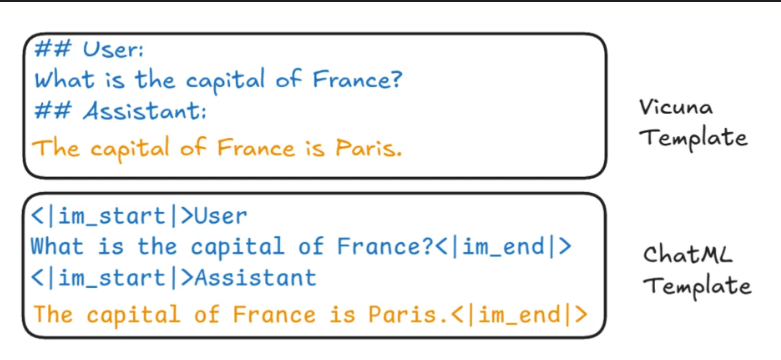
Article content One particularly important keyword you’ll see is <|im_end|>. This is like a digital mic drop it’s the model’s way of saying, “Okay, I’m done!” When the model generates this keyword, it stops generating more text. At inference time (when you’re using the model in real-time), seeing this stop token tells the system that it’s time to wrap up the response and call it a day.
Most models stick to one specific prompt template, like OpenAI’s ChatML or Mistral’s unique format. Since the model has been fine-tuned to recognize just one template, feeding it input in any other format can confuse it. It might end up reverting to simple text prediction mode, instead of following your instructions. Think of it like talking to someone who only understands the directions "left" and "right" if you suddenly start saying "north" or "south," they’ll just keep guessing until they’re completely lost.
Pro tip: Always make sure your input follows the exact prompt format your model was trained on. Even a stray newline or extra space could cause your perfectly crafted prompt to fall flat, making the model’s output way less accurate. So, treat those templates like sacred scrolls!
- LLMs Don’t “Pick” Words—They Roll the Dice Here’s a fun twist: LLMs don’t just decide on the next word like a writer carefully choosing the perfect adjective. Instead, they generate a probability distribution a mathematical guess about what the next word could be, based on a giant predefined vocabulary. This vocabulary can contain around 128,000 words, so there’s a lot to choose from!
Now, you might be wondering, “If LLMs only give probabilities, how do we get actual words?” Great question! That’s where sampling comes in. Sampling is the process of picking one word from the sea of possibilities, guided by the probability distribution the model generates. The simplest way to do this is called greedy sampling. As the name suggests, we just snatch the word with the highest probability at each step. It’s a quick way to get a result, but like many things in life, being greedy doesn’t always lead to the best outcome it doesn’t think ahead!
There are also more advanced sampling strategies that spice things up, using parameters like temperature, top-p, and top-k to decide how creative or controlled the output should be.
Temperature controls randomness. A low temperature (like 0 or 0.2) makes the output more deterministic and precise, which is great for coding or logical tasks where you want consistency. Think of it like driving a car,low temperature is cruise control on a straight highway. A higher temperature (like 0.8 or 1), on the other hand, makes the model's output more creative and unpredictable perfect for storytelling or role-playing. It’s like taking a scenic route with lots of twists and turns, where anything can happen!
Top-p and top-k further refine how much randomness you allow by either restricting the sampling to a subset of high-probability words (top-k) or selecting from a variable range of probable words based on their cumulative probabilities (top-p). These parameters can dramatically influence the model's creativity, coherence, and even its personality!
If this all sounds intriguing and you’d like a deep dive into the art of sampling strategies, drop me a note. I might just write a dedicated post on it!
- LLMs Speak “Token,” Not Words While we’ve been talking about words, let’s set the record straight: LLMs don’t actually work with words as we know them. Instead, they operate in the secret language of tokens. When you input text into an LLM, the first thing that happens is tokenization, which is a fancy way of saying that the text gets chopped up into smaller pieces, these are the tokens.
In most modern LLMs, tokens are typically words, parts of words, or even just characters. They’re like the building blocks the model uses to understand and generate language. The tokenizer decides how your text is split up, and this predefined set of tokens forms the model’s vocabulary.
Now, once an LLM is trained on a specific tokenization method, it’s set in stone. You can’t just swap out the tokenizer or update the vocabulary on the fly—if you want the model to recognize a different set of tokens, you’ll need to train the whole thing from scratch. It’s like trying to switch a car engine from gasoline to electric, you can’t just flip a switch, you need a complete overhaul.
So, while it may seem like LLMs are reading and writing in human language, they’re really thinking in tokens, a kind of intermediate code that bridges human language and machine understanding. And once those tokens are locked in, the model sticks with them, no exceptions!
Here's a rewrite of section 6 with examples to make the concept clearer and more engaging:
- LLMs Speak in Numbers: The World of Token IDs While we’ve been discussing tokens, here’s the plot twist: LLMs don’t actually process tokens directly. These models are powered by artificial neural networks (ANNs), and ANNs only speak one language, numbers. They don’t really understand text or strings the way we do.
So, how do we get from text to numbers? After the text is tokenized into discrete tokens (like words or sub-words), those tokens need to be converted into token IDs, essentially, integers that represent each token. This process is still handled by the tokenizer, which assigns each token a unique ID based on its position in the model’s predefined vocabulary.
Let’s Break It Down with an Example: Imagine you input the phrase:
"Mahdi is awesome." First, the tokenizer steps in, breaking the phrase into tokens. Depending on the model’s tokenizer, the tokens might look like this:
"Ma" "h" "di" "is" "awesome" "."
Next, each of these tokens gets translated into a number, called a token ID. So, in our example, it could look something like this:
"Ma" -> 24958 "h" -> 417 "di" -> 789 "is" -> 90 "awesome" -> 1728 "." -> 12
Now, instead of words, the LLM sees:
[24958, 417, 789, 90, 1728, 12] These numbers are the input the neural network actually processes. Each token ID represents a position in the vocabulary, and from here, the model generates probabilities to predict the next token ID.
Why Does This Matter? Understanding that LLMs process numbers, not words, helps clarify how flexible (or not) these models are. Once the text is tokenized and encoded into IDs, those numbers are fed into the neural network where all the magic, calculating probabilities, making predictions, etc. happens. But here’s the catch: if you want to change the vocabulary or how the tokens are represented, you have to re-train the model entirely. No quick fixes here!
Another Example for Fun: Let’s take the phrase:
"Math is life." The tokens might be:
"Math" -> 502 "is" -> 90 "life" -> 204
Which translates to:
[502, 90, 204] Once the model processes these IDs, it will predict the next token ID based on the context. And depending on its training, it might suggest something like "!" (ID 33) to finish the sentence.
In essence, while we see words, the model only sees numbers. And these numbers are what power the model’s incredible ability to generate coherent responses, summarize articles, and even suggest pizza toppings (pepperoni or pineapple, anyone?).
Here's a playful and professional rewrite of section 7 with some added clarity:
- Transformers Speak in Vectors, Not Integers
So far, we’ve discussed how LLMs use token IDs generated by the tokenizer, but here’s where things get really interesting: the transformer, the powerhouse behind the LLM, doesn’t work with those token IDs directly. Instead, it expects a sequence of multi-dimensional vectors. Cue the embedding!
The embedding block is the first step in the LLM’s journey. Its job is to convert those integer IDs into vectors, which are essentially multi-dimensional representations of the tokens. This transformation allows the model to understand the meaning behind the words.
Let’s Dive into Embeddings When each token ID is fed into the embedding block, it’s projected into a space defined by something called the embedding dimension. In this space, tokens with similar meanings, like “booking” and “reservation”, will have vectors that are close together. It’s like putting related books on the same shelf in a library: the closer they are, the more they have in common!
For example:
"cat" might be represented as the vector [0.1, 0.5, 0.3] "dog" could be [0.2, 0.4, 0.3]
These vectors are similar because they represent concepts that are related, both being pets, for instance. The similarity can be measured using methods like dot product or cosine similarity, allowing the model to gauge how closely related different tokens are.
The Position Embedding Layer But wait, there’s more! In addition to the token embedding layer, there’s also a position embedding layer. This layer encodes information about the position of each token relative to others in the sequence. Why is this important? Well, the meaning of a sentence often hinges on the order of words. Think of "The cat chased the dog" vs. "The dog chased the cat."
The position embedding layer often has a maximum position hard-coded, which means there’s a limit to how many tokens the model can handle in one go. If you try to input a longer text than it supports, you might end up with incoherent or unexpected output, like mixing up your coffee order with your pizza toppings!
In summary, while LLMs start with integer token IDs, the transformer takes those IDs and transforms them into meaningful multi-dimensional vectors that capture the essence of the words. This transformation is crucial for understanding language and generating coherent, contextually relevant responses.
Summary: Unpacking the Magic of LLMs Let’s wrap up our exploration of how LLMs work:
First, we format our query using the correct instruction template. This query is then tokenized and encoded into a sequence of token IDs. This sequence is sent to the model, which generates a probability distribution based on the input. From this distribution, we sample one token and append it to the existing sequence of token IDs to create a new prompt. We repeat this process until the model indicates it’s finished generating the response by outputting the stop token.
We’ve traveled from the straightforward idea of an AI assistant to the intricate mechanics of tokenization and embedding. While LLMs may seem smooth on the surface, their underlying complexity is truly profound. By grasping these fundamental building blocks, you now possess a powerful toolkit to unlock the potential of these remarkable models.
Remember, LLMs are tools much like a hammer or a paintbrush, their effectiveness hinges on your understanding. With a deeper comprehension of their workings, you can refine your prompts, anticipate potential challenges, and, most importantly, know how to troubleshoot issues.
Thank you for taking the time to read this post!